DESIGN SYSTEM TO CX DIAGNOSTIC
01 - The Brief
A design system that couldn't be built
I was hired to scale a design system. Within five months that brief had dissolved — the engineering team had been reduced to firefighting, nothing new could be shipped, and a possible Shopify migration was making the existing system potentially redundant. I am the sole designer in an organisation with no established UX or CX practice, fragmented ownership of the experience, during a period of strategic uncertainty.
Rather than wait for the situation to resolve, I redirected toward the most useful thing I could actually do: understand what was happening with the business and its customers before anyone decided what to build next.
SCOPE - Professional
TOOLS - Figma, Miro, Web Analytics Tools, AB Testing Platform
ROLE - CX Strategy, Service Design, User Research, Experimentation Framework, Stakeholder Management
Timeframe - 2025 to ongoing
02 - The Signals
The data was incomplete. The picture was still clear.
Analytics data was partial due to high cookie consent rejection. A second platform used business-specific KPI definitions that made interpretation difficult. Rather than wait for clean data, I triangulated across sources - being explicit about what I knew, what I was assuming, and where the gaps were.

Revenue was holding — but only because precious metals prices had risen consistently. Underneath a stable revenue line, the business's ability to convert interest into sales had been quietly eroding. The risk was being masked by an external market factor.
Conversion Rate
~25% ↓
Relative Drop
Declining conversion efficiency — The number of visitors were up year on year but the site wasn't converting them. This was not a reach problem. It was an experience problem but where and why was the business losing conversions?
03 - Customer Understanding
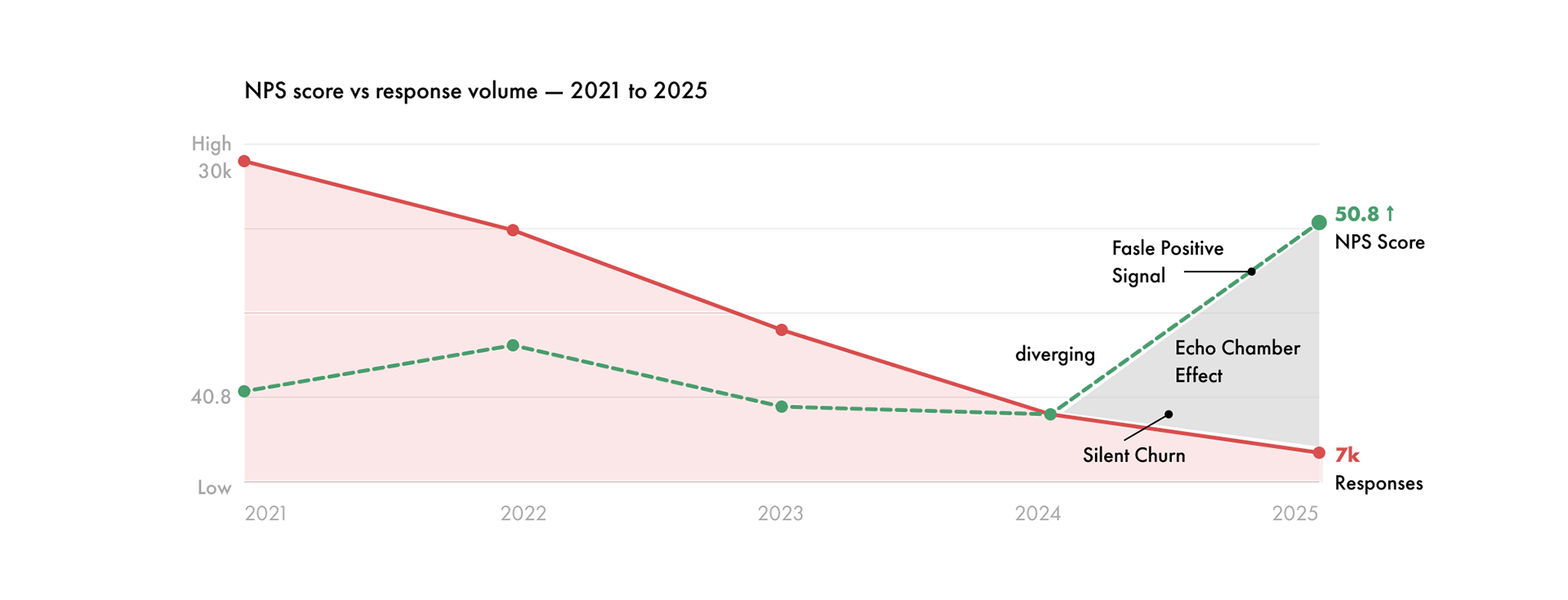
⚠ Echo chamber effect: as dissatisfied customers stopped responding, the pool skewed toward loyal regulars. The improving NPS score was masking a disengaging customer base — not reflecting a genuinely improving experience. Decisions based on this score alone would be systematically misleading.
NPS survey participation fell by 76% between 2021 and 2025 — while the score itself improved. Over the same period, the share of established loyal customers among respondents nearly doubled, while newer customers represented less than half their original proportion. The pool was narrowing, not broadening. The score was no longer a reliable signal of broader customer sentiment.
Built from scratch using what existed.
No research infrastructure. No interviews. No usability testing programme. Using a 2020 customer survey alongside competitive research, I developed working customer profiles — with the assumption that the survey would be valid for 5 years and explicitly framed as informed hypotheses, not definitive answers. These gave me a reference point for decisions.
The rest of this case study is protected
The following sections cover the full audit and redesign, post-purchase communication restructure, experimentation framework, and outcomes. They contain process detail and unpublished work.